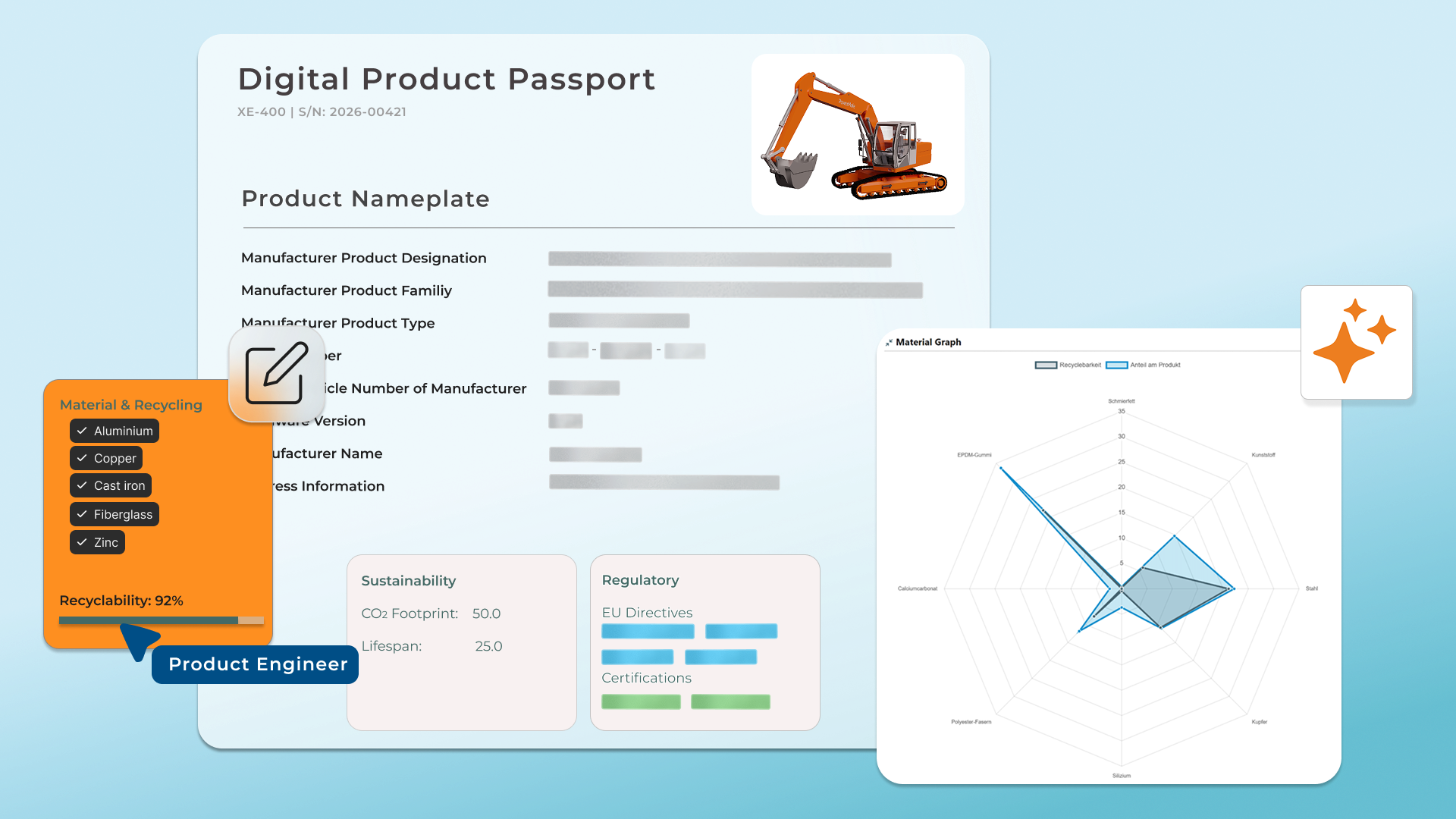

EM_DigitalProductPassport_1920x1080_xde

    The Digital Product Passport: What’s Behind It?

    The Digital Product Passport (DPP) is becoming increasingly important with the EU Ecodesign Regulation (ESPR). The Packaging Regulation (PPWR), the new Machinery Regulation, and future delegated acts also introduce new requirements for product information. Those who wait for the final requirements usually start too late. A structured, consistent database helps you prepare today, avoid data chaos, and make the most of your existing product knowledge.

    Learn more in our blog post.

    Go to the Blog
    gi-kl-1367303272-1920x1080

    Your Benefits at a Glance

    Time Savings

    Existing product information and system integrations are reused. The effort required for DPP implementation is significantly reduced.

    Flexibility

    The data model can be adapted to meet individual and regulatory requirements, even as those requirements evolve.

    Transparency

    You’ll gain a consistent overview of product information, its relationships, and its origin throughout the entire product lifecycle.

    Data Timeliness

    By connecting to existing data sources, your Digital Product Passport stays up to date with minimal manual maintenance.

    Access to Information

    Relevant product information is provided in a manner tailored to the target audience and based on role, and in multiple languages if necessary.

    Interoperability

    The Knowledge Graph makes product data usable across system boundaries, including based on standardized models such as the Asset Administration Shell (AAS).

    Your Path to the Digital Product Passport with Empolis Industrial Knowledge

    01

    Connect Product Data

    Existing data sources such as ERP, PLM, PIM, DMS, MES, CRM, or QMS are connected and integrated with Empolis Industrial Knowledge. This creates a central access layer for existing product knowledge without replacing established systems.

    02

    Structure Product Knowledge for the DPP

    The Empolis Knowledge Graph connects product information across the entire lifecycle. An extensible DPP data model complements this foundation with the required entities and attributes. ECLASS, ETIM, and the EN 182xx standard series provide guidance for a standardized structure. Asset Administration Shells can be integrated and utilized for cross-system data exchange.

    03

    Provide the Digital Product Passport

    Deliver DPP information through a web-based, mobile-friendly product passport view in your own design. Based on your DPP data foundation, machine-readable and user-friendly formats such as HTML and PDF can be generated. Role-based access rights and audience-specific views enable information to be provided as needed and, if required, in multiple languages. Additional documents and service knowledge can be integrated directly.

    04

    Make the Product Passport Accessible

    Access the Digital Product Passport directly via a simple scan. Connect physical products to their Digital Product Passport using a suitable carrier, such as a QR code. Persistent product identification and flexible redirection ensure access to the latest valid product information at all times.

    Why Empolis Is the Right Solution for the Digital Product Passport

    Connecting Data, Breaking Down Silos

    Empolis has been integrating various data sources for years. As a result, product and process information is no longer stored in isolated silos but in a shared database.

    Structured Representation of Product Knowledge

    Knowledge graphs comprehensively map products, components, variants, and their metadata. The DPP is not a separate project, but rather part of the graphs that Empolis is already implementing.

    Making Knowledge Accessible and Expanding It

    Empolis contributes existing content and expands it in a targeted manner, both for the DPP and for service, training, and documentation.

    The Cost of Doing Nothing

    Those who wait too long with the DPP or rely on isolated, stand-alone solutions risk having to do the work twice. With Empolis, you can integrate the Digital Product Passport and intelligent knowledge management right from the start.

    Don't Start from Scratch

    Thanks to years of expertise and pre-built, industry-specific blueprints, a structured knowledge model can be built efficiently. This allows the foundation for the DPP to be established more quickly.

    Leverage Existing Knowledge Graphs

    As an Empolis customer, you benefit from your existing knowledge graph and can expand it specifically to include DPP-relevant information, rather than starting from scratch.

    Companies That Trust Us

    Empolis: A Partner That Has Been Integrating Product Data for Years

    The data foundation for the DPP is usually already within your company, spread across ERP, PLM, MES, and documentation systems. Empolis Industrial Knowledge brings these sources together and supplements them with practical knowledge from the product lifecycle.

    • Proven knowledge graph technology: Products, components, and variants have been mapped in graphs for years. The DPP builds on this structure.
    • Pre-built blueprints: Industry-specific models speed up the launch, so you don’t have to start from scratch.
    • No siloed solution: A single data model simultaneously supports DPP, service, documentation, and training.
    • Open standards: The integration of ECLASS, ETIM, and Asset Administration Shells ensures interoperability.

    Discover the Capabilities of Empolis Industrial Knowledge

    gi-kl-943067460-1920x1080

    Access & Integrate

    Seamless data access and smooth integration: The Empolis solution integrates effortlessly with existing IT infrastructures and production systems.

    gi-kl-1485309138-1920x1080

    Collect & Organize

    Systematic recording, targeted structuring: Empolis enables the company-wide collection of expert knowledge, process data, and empirical findings.

    gi-kl-1357100011-1920x1080

    Transfer & Governance

    Share knowledge effectively and manage it in a controlled manner: with role-based access controls, automated knowledge flows, and compliance-compliant documentation.

    FAQ

    • A standardized, product-specific, and machine-readable data record that is linked to a physical product via a QR code or similar data carrier.

    • The Asset Administration Shell is a standardized digital representation of a physical or digital asset, such as a product, a machine, or a software module. It organizes the associated information into uniform data models, thereby enabling data exchange across manufacturers and systems.

    • Every company has different circumstances, data landscapes, and requirements for the Digital Product Passport. That is why implementing the DPP with Empolis Industrial Knowledge is not a standardized, off-the-shelf product, but rather takes place as part of a customized, guided project. Working closely with you, we first analyze your existing data, develop an initial functional prototype, and gradually expand it into a solution ready for production use. Our experts guide you through the entire process—from the initial analysis through technical integration to customized expansion and scaling. The result is a Digital Product Passport that is tailored to your existing system landscape and can be flexibly adapted to future requirements.

    • Create your product's CO2 footprint with Empolis' sister company Enit (ENIT is becoming part of the proALPHA Group)

    • A Digital Product Passport (DPP) contains important information about a product and its entire life cycle. This includes, among other things, product identification, manufacturer information, materials and components, origin and supply chain, as well as details on sustainability and resource consumption. Information on service life, repairability, maintenance, safety, and compliance may also be included in the DPP.

      Which specific data is mandatory depends on the respective product group and the applicable regulatory requirements. This is because the mandatory DPP content and data models have not yet been defined for all industries and product groups. These are being gradually specified within the framework of European regulations. With Empolis Industrial Knowledge, companies can already link relevant product information and make it available in a structured format. The flexibly expandable DPP data model makes it possible to incorporate new requirements as soon as they are defined.