
RAG Meets Knowledge Graph: A New Level of Chatbot Interaction Back to the Blog
Published: May 11, 2026
The Key Points in Brief
The integration of knowledge graphs into LLM chatbots marks a significant advancement in the field of information processing. By systematically structuring data, a powerful platform is created that enables chatbots not only to respond to queries, but also to carry out deeper comprehension and learning processes. This leads to an improved ability to diagnose complex problems, offer tailored solutions, and anticipate potential developments. The knowledge graph serves here as a central mechanism that enables chatbots to link relevant information and provide it in a contextualized manner, resulting in more effective interaction between humans and machines.
Where human thought meets human speech
The expansion of the Retrieval Augmented Generation (RAG) approach to include integration with knowledge graphs marks the hybrid state-of-the art approach to interacting with knowledge in a natural language. This synergy between RAG and knowledge graphs opens up new dimensions of interaction quality and response accuracy that go far beyond what is possible with conventional systems based on unstructured documents such as PDFs, Excel, etc. The key to this progress lies in the structured nature of knowledge graphs, which offer a semantically rich, interconnected data landscape.
What is a knowledge graph?
At the heart of many of the solutions we use every day is a technology that translates the way we humans think and store knowledge into digital form. To understand the depth and complexity of this endeavor, let's look at a real-life moment, one that demonstrates the power of human cognition and the possibility of emulating it through knowledge graphs.
Imagine I am talking to my four-year-old son about cars. He is fascinated by the fact that some cars make noise while others drive almost silently. He wants to understand this, and to explain it to him, I build a simple chain of reasoning that a four-year-old can understand. I explain to him that there are two types of cars: Internal combustion cars and electric cars. The cars with internal combustion engines, I say, have a tank that is filled with gasoline - a liquid that they "drink" from the gas station in the next town. This gasoline is burned in the engine, it literally explodes, similar to fireworks, only much more often and faster. The sound of the explosions is what we hear.
Then I explain the electric cars to him. These cars are not fueled with gasoline, but charged with electricity, similar to how we charge toys via the socket. As nothing is burned, they are very quiet.
If I ask my son later whether a car that comes from the filling station is an electric car or a combustion engine, he will probably answer correctly that it is a combustion engine. This is because he has not simply stored the information as loose facts. Instead, he has organized it into a mental model that establishes relationships between different concepts - cars, gasoline, gas stations, sounds. This story illustrates how, even at a young age, our brains are capable of storing knowledge in an interconnected system of cause and effect.
It is precisely this ability to store and retrieve knowledge in a networked system that we are trying to replicate in the digital world with knowledge graphs. A knowledge graph is a representation of knowledge in a graph structure where entities are connected by edges that represent their relationships to each other. These entities can be concepts, places, objects or people, and the edges describe how these entities relate to each other.
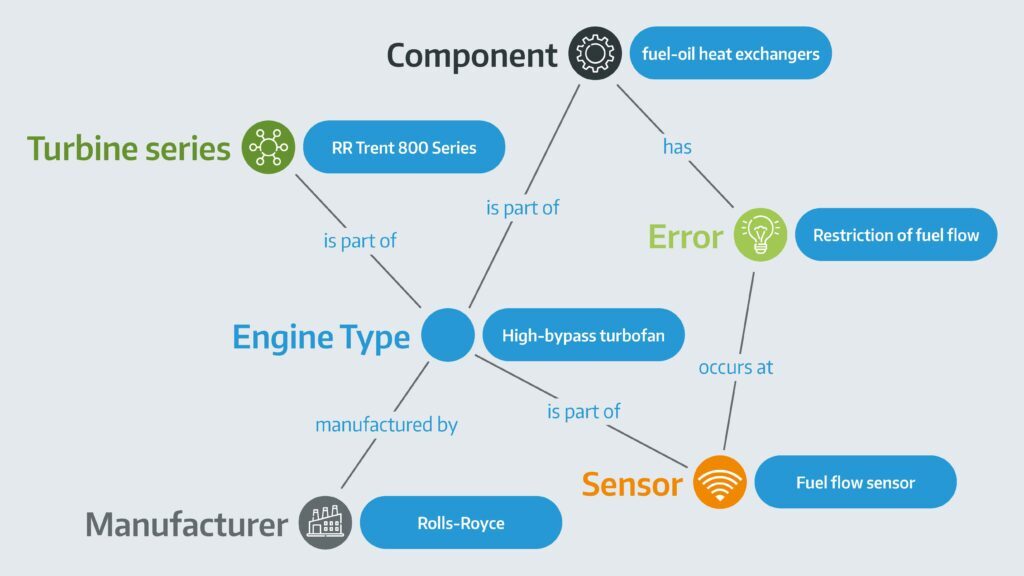
The integration of such a knowledge graph into a chatbot pushes the boundaries of what is possible with artificial intelligence. Instead of relying on a database of pre-built answers, a knowledge graph-based chatbot can answer complex queries by understanding the relationships between different entities. It can draw conclusions and generate answers that are not only relevant but also contextually appropriate.
Such an approach allows the chatbot, similar to my son, to understand complex relationships and answer questions that require a deep understanding of the subject matter. The chatbot could recognize that a car that has just come from the petrol station probably runs on petrol and is therefore an internal combustion engine. This ability not only to store knowledge, but also to interpret and apply it in context, opens up new dimensions of interaction and knowledge exchange between humans and machines.
By replicating the way humans think and organize knowledge, knowledge graphs bring us one step closer to creating technologies that can not only deliver information, but also understand and build on it. They enable a form of artificial intelligence that not only reacts, but also learns, understands and adapts - much like a curious child discovering the world around them.
LLM chatbots with different RAG approaches: knowledge graph vs. documents
To illustrate the advantages of an LLM chatbot based on knowledge graphs or the RAG principle in the area of service management, especially in comparison to a system that accesses unstructured data such as PDFs, we will focus on specific examples from support and field service. These examples illustrate how the integration of a knowledge graph or the RAG principle can increase the efficiency and effectiveness of services.
Examples
Example 1: Complex fault diagnosis in technical support
Knowledge Graph+RAG LLM chatbot: A customer reports a problem with a complex device, such as an industrial printer. The chatbot, which is based on a knowledge graph, analyzes the error description and compares it with similar cases and their solutions. By linking information on device types, known problems, software versions and error codes, the chatbot can ask specific questions to diagnose the fault and suggest precise solutions. For example, the chatbot could recognize that the error often occurs with a certain software version and recommend a specific update.
Unstructured data LLM chatbot: A chatbot that only has access to a collection of manuals and technical documents can offer the customer general solutions, such as restarting the device or checking the cable connections. However, it lacks the ability to make in-depth diagnoses or offer specific solutions for the software version or error code.
Example 2: Ordering spare parts in Field Service
Knowledge Graph+RAG LLM chatbot: A service technician on site urgently needs a spare part for a repair. The chatbot can immediately check the compatibility of the spare part with the specific model of the device, check availability and suggest alternative options if the required part is not immediately available. By combining product information, stock levels and delivery logistics, the chatbot can help the technician to plan and carry out the repair efficiently.
Unstructured data LLM chatbot: With access to unstructured data such as product catalogs or stock lists, the chatbot could provide information on spare parts, but without a direct link to specific device models or current stock levels. This could lead to delays if the technician first has to manually check compatibility and clarify availability.
Example 3: Instructions for troubleshooting
Knowledge Graph+RAG LLM chatbot: In the event of a problem with a software application, the chatbot can offer targeted troubleshooting steps by understanding the application architecture and common sources of error. For example, if a user reports problems with printing in an accounting program, the chatbot can immediately identify that a recent update addresses specific printing issues and provide the user with detailed instructions on how to update.
Unstructured data LLM chatbot: A chatbot that relies on a database of generic instructions could provide the user with general troubleshooting tips, such as checking printer settings or restarting the program. These suggestions could be helpful, but do not provide specific solutions for known bugs that have been fixed by updates.
Example 4: Predictive maintenance recommendations
Knowledge Graph+RAG-LLM chatbot: Based on the service history and data analysis of device failures, the chatbot can make predictive maintenance recommendations. For vehicle fleet management, for example, the chatbot could recognize that certain vehicle types tend to have specific problems at certain mileages and recommend preventive maintenance accordingly.
Unstructured data LLM chatbot: Without the ability to recognize complex patterns in the data and link them to specific maintenance recommendations, a chatbot could only suggest general maintenance intervals based on manufacturer specifications. As a result, potential specific problems that could be identified by analyzing service data are not addressed.
The examples presented here are just a few of the many possible scenarios that demonstrate the potential and challenges of using LLM chatbots, especially when they work with knowledge graphs or on the basis of the RAG principle. They illustrate that not only a well thought-out AI infrastructure is crucial for an optimal user experience, but also the quality and structure of the information base that the chatbot accesses.
These examples underline the importance of careful planning and implementation of the information base that forms the core of any intelligent system. A well-structured, connected and rich data source can significantly improve a chatbot's ability to provide accurate, contextual and helpful responses. This in turn increases user satisfaction and engagement.
Knowledge graph-based LLM chatbots can be a powerful way to efficiently process complex information and deliver precise, contextually relevant answers to users. The decision to adopt this technology should be carefully weighed by balancing the advantages against the challenges and the effort required.
The simpler a product portfolio is in terms of depth (complexity) and breadth (variety), the less economically viable it is to use a knowledge graph as a representation. On the other hand, a rich and complex product portfolio mapped through a knowledge graph offers considerable advantages. In such cases, the knowledge graph not only significantly improves the handling and analysis of information, but also helps uncover new insights and connections within the product portfolio that drive innovation and enhanced customer service.
It should also be noted that a knowledge graph can serve not only chatbots, but also many different applications, touchpoints, and usage scenarios using the same semantic logic — though a comprehensive discussion of these possibilities would far exceed the scope of this chapter. Choosing the right information foundation and carefully planning the AI infrastructure are crucial to ensuring the best possible user experience.
Knowledge graph-based LLM chatbots can be a powerful way to efficiently process complex information and deliver precise, contextually relevant answers to users. The decision to adopt this technology should be carefully weighed by balancing the advantages against the challenges and the effort required.
The simpler a product portfolio is in terms of depth (complexity) and breadth (variety), the less economically viable it is to use a knowledge graph as a representation. On the other hand, a rich and complex product portfolio mapped through a knowledge graph offers considerable advantages. In such cases, the knowledge graph not only significantly improves the handling and analysis of information, but also helps uncover new insights and connections within the product portfolio that drive innovation and enhanced customer service.
It should also be noted that a knowledge graph can serve not only chatbots, but also many different applications, touchpoints, and usage scenarios using the same semantic logic — though a comprehensive discussion of these possibilities would far exceed the scope of this chapter. Choosing the right information foundation and carefully planning the AI infrastructure are crucial to ensuring the best possible user experience.
We look forward to a no-obligation conversation and would be happy to work with you to determine which product offers you the greatest added value. Let us together make better decisions, faster.
Pros and cons of knowledge graph-based LLM chatbots
There is no royal road to valuable insights. This is especially true for the integration and use of knowledge graphs in LLM chatbots. The decision to embrace this advanced technology is not a step to be taken lightly. If the implementation were trivial, all companies would have taken this path long ago.
The implementation of a knowledge graph-based system signals a high level of maturity of knowledge management within an organization. Not every company is willing or able to jump straight to this level. Careful consideration of the pros and cons is required in order to make an informed strategic decision. It is therefore essential for decision-makers to weigh up the complexity and potential benefits against the required effort and possible limitations.
This decision is based not only on a technical evaluation, but also on a comprehensive consideration of the organizational structure, the existing data quality and availability as well as the long-term corporate goals. Implementing a knowledge graph is more than just a technical project; it is a strategic endeavor that involves profound changes in the way information is managed and used.
Ultimately, it is about building a bridge between the current state of knowledge management and the visionary goal of an intelligent, data-driven organization. The pros and cons list serves as a guide based on our experience in such projects and is intended to help decision-makers navigate the complexity of this endeavor and make a well-considered choice.

Conclusion
Knowledge graph-based LLM chatbots can be a powerful way to efficiently process complex information and deliver precise, contextually relevant answers to users. The decision to adopt this technology should be carefully weighed by balancing the advantages against the challenges and the effort required.
The simpler a product portfolio is in terms of depth (complexity) and breadth (variety), the less economically viable it is to use a knowledge graph as a representation. On the other hand, a rich and complex product portfolio mapped through a knowledge graph offers considerable advantages. In such cases, the knowledge graph not only significantly improves the handling and analysis of information, but also helps uncover new insights and connections within the product portfolio that drive innovation and enhanced customer service.
It should also be noted that a knowledge graph can serve not only chatbots, but also many different applications, touchpoints, and usage scenarios using the same semantic logic. though a comprehensive discussion of these possibilities would far exceed the scope of this chapter. Choosing the right information foundation and carefully planning the AI infrastructure are crucial to ensuring the best possible user experience.
Empolis