Linking the content of information creates context for users. This creates a digital image of entrepreneurial know-how - for more far-sighted decisions.
Optimize search results thanks to contextual information
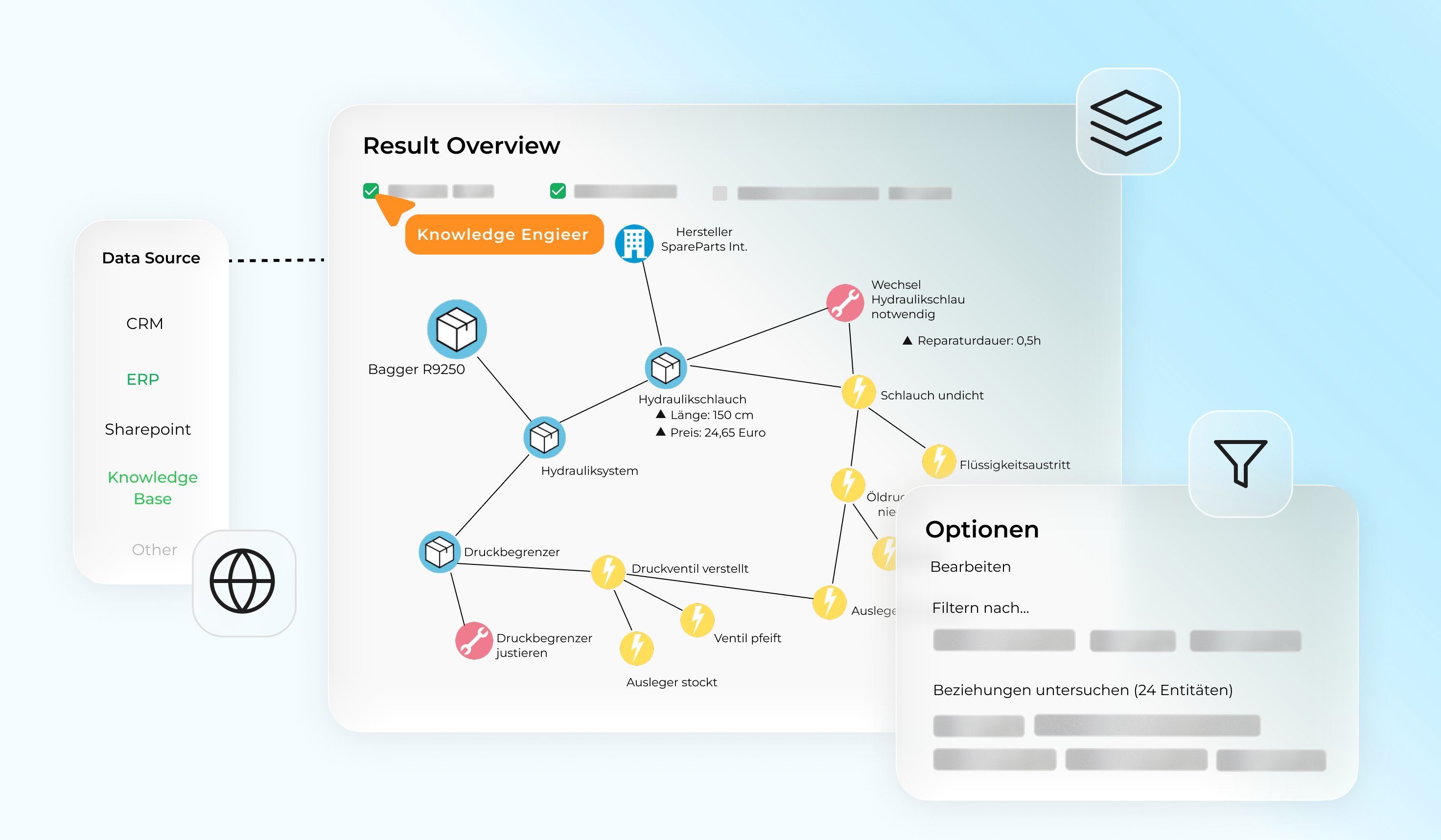
The semantic linking of data is what makes knowledge graphs so effective. In addition to the search query, users can find alternative spare parts, contact persons or information on required special tools - controllable according to role and purpose. This allows complex data structures to be organized efficiently and dependencies remain traceable at all times.
Structure product knowledge more easily
Knowledge graphs make it easier to map and manage complex product properties, variants and relationships thanks to graphically modelable knowledge maps - ideal for industry and manufacturing. Implement via drag and drop without the need for programming knowledge. Thanks to the visualization, complex relationships always remain transparent and comprehensible.
Driving automation forward
The automatic control of machines or processes requires a lot of valid information. As a link, the Knowledge Graph makes the existing data from different data sources machine-readable. The linking of intelligent systems offers more security for planning and implementation. This relieves employees, for example, in impact analyses or situation assessment.
Overcoming data silos
Based on an error code, you can directly identify the component in question and trace the device or manufacturer. This makes it easier to check stock levels or order modalities, for example. In this way, you can overcomeexisting silo structures with just a few clicks, without having to switch between applications and losing valuable time.
Intelligent linking instead of islands of information
Knowledge graphs are extremely powerful and flexible when it comesto identifying only relevant information from different data sources. This content-based networking creates a digital image of your organization, products and processes - flexible, scalable and always up-to-date.
Relationships between objects are displayed graphically in a configurable, comprehensible model view. This allows users without programming knowledge to visualizespecific topics using domain knowledgeand digitize their knowledge.
Existing knowledge is contextualized and enriched with meaning in order to capture implicit knowledge and take it into account in impact or feasibility analyses, for example. The graphic visualization also helps to uncover potential conflicts or justify recommendations.
The Knowledge Graph can run through various scenarios in theory in order to better understand possible effects and consequences. All recommendations for action are presented in a comprehensible and logical structure.
Your advantages
The use of knowledge graphs together with modern knowledge management offers you this added value :
Intelligent networking of specialist terminology
Intuitive handling thanks to modeling of requirements
Optimal use of data thanks to simple import of various data types (e.g. Excel, RDFS, OWL)
Frequently Asked Questions
In our FAQ articles you will find information on frequently asked questions.
A knowledge graph is a type of visualized knowledge model that presents information, data and their relationships in a structured and networked way. This creates a digital image of products, processes or entire companies.
While traditional databases primarily store data in tabular form, a knowledge graph focuses on the relationships between individual pieces of information. This makes connections visible that often remain hidden in traditional systems. Search queries can be supplemented with contextual information and offer users a better overview in order to better assess situations or weigh up the consequences of different options for action.
They enable quick access to context-related, cross-divisional information - for example, when servicing or diagnosing faults. Complex product relationships, variants and metadata can be mapped transparently and flexibly. This means that the quality of advice for customers and partners no longer depends on the individual level of knowledge of the employee - and the quality of processes and advice can be increased across the board.
Existing data sources can be easily integrated via standardized interfaces (e.g. Excel, RDFS, OWL or APIs) and used as part of the Knowledge Graph. Thanks to open interfaces and integration options, the Knowledge Graph can be easily integrated into existing IT landscapes.
No, the Knowledge Graph from Empolis is a user-friendly modeling tool with which you can define, model and adapt structures and relationships with a click - without any programming knowledge.
Discover the capabilities of Empolis Industrial Knowledge
Access & Integrate
Seamless data access and smooth integration: The Empolis solution links effortlessly with existing IT infrastructures and production systems.
Share knowledge effectively and manage it in a controlled manner: with role-based approvals, automated knowledge flows and compliance-compliant documentation.
























































.jpg?width=400&height=200&name=limtronik-i40-lg%20(1).jpg)









.jpg?width=400&height=200&name=gaudlitz-lg%20(1).jpg)



.jpg?width=400&height=200&name=eckerle-gruppe-lg%20(1).jpg)









.jpg?width=400&height=200&name=aichinger-lg%20(1).jpg)
.jpg?width=400&height=200&name=advaltech-lg%20(1).jpg)