
An article by Eric Brabänder, CPO, Empolis
Whether it's the internet, the cloud or generative AI - every technological revolution brings with it exaggerated expectations. And yet, according to "Amara's Law", in the long term they have often profoundly changed the way we work, think and live. The new hype topic of "Agentic AI" - a new approach to artificial intelligence (AI) that not only answers questions, but also solves tasks independently - could be part of this tradition. Not just short-term hype, but the beginning of a new era?
What is Agentic AI - and what is it not?
There is often confusion in the discussion surrounding AI. What is generally referred to as AI today ranges from rule-based expert systems and machine learning to generative processes with language models, such as ChatGPT. But agentic AI goes one step further: these are software-based agents that can pursue goals, make decisions and carry out actions independently - without any constant human input.
The key difference: while classic chatbots or simple AI assistants react to input, agents act proactively. They independently recognize what needs to be done, plan the next steps, access tools and data sources - and act in a goal-oriented manner.
"Agentic AI" is a collective term for an entire class of intelligent systems that exhibit agent-like behavior and interact with each other.
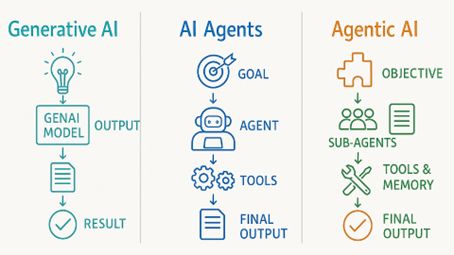
The graphic below provides a clear illustration of the differences: Generative AI generates content in the dialog assistant directly from a trained model - for example texts or images - without any further contextual reference. AI agents, on the other hand, actively pursue a defined goal (e.g. researching technical information and issuing the correct instructions for a repair), use additional tools (e.g. search procedures, knowledge databases, queries to humans or queries about product properties) and generate a refined result.
Agentic AI goes one step further: it coordinates several sub-agents, has access to tools or other agents and a memory and is able to proactively pursue complex goals over several steps. This creates a system that not only executes tasks, but also plans, decides and delegates independently. This transition from selective to strategic process support is central to industrial applications. Some agentic AI systems are designed to work highly autonomously, others semi-autonomously in cooperation with humans. But they all have one thing in common: they are designed to relieve, support and actively help shape processes.
What does it take for agents to work?
From a technical perspective, agentic AI systems consist of several interlocking components. They take in information from their environment, process it, make decisions, use tools - and carry out actions. At the same time, they must be safeguarded by so-called "guardrails" in order to avoid wrong decisions or unwanted behavior or the output of false information. It is therefore always a question of striking a balance between autonomy and control. Agent systems of this kind could therefore reduce workload, make decisions easier and automate processes more efficiently.
These interacting agents should be as modular as possible and should not have to be completely new or developed in-house. Especially if there are already established and running systems, such as ERP, CRM, QA or enterprise knowledge management systems, which contain the data, information and knowledge required for the agents' decisions and actions. In future, therefore, business-ready solutions will be needed - preferably modular and integrable via API.
Empolis therefore relies on preconfigured AI apps that can be integrated directly into existing ERP or CRM systems. These apps analyze support requests, provide product information, help formulate the right solutions or offer interactive support for maintenance teams and service technicians - with one click, without training.
From theory to practice: agents in the industry
What initially sounds like science fiction is already a reality in some areas of application - for example in industrial customer service. At robot manufacturer KUKA, for example, an intelligent dialog-based AI agent helps thousands of users to solve technical problems efficiently every day. The interactive and intelligent dialog assistant is implemented as an agent and asks specific questions, accesses approved technical documentation and uses various tools to find the right answer. It searches for the right solution in more than 3 million documents, actively asks the person if they do not yet have all the information to provide the right answer or resolves the query according to product groups and detailed information. People no longer need to know everything themselves - the agent finds the knowledge for them.
We are also increasingly seeing concrete application scenarios in sales, production planning, maintenance or on the store floor. Whenever processes are recurring, knowledge-intensive and time-critical, agents come into their own. For medium-sized companies in particular, this offers enormous potential for increasing efficiency. But what expectations can be placed on fully autonomous agentic AI systems?
However, trust requires traceability - and realistic expectations
In addition to the ease and speed of integration, a key issue when introducing agentic AI is the question of security and trust. Because as soon as a system makes decisions, it must be possible to understand the basis on which this is done. We must not forget that many agent-based systems still suffer from clear weaknesses: They are often based purely on LLMs, which tend to hallucinate, get into endless loops or make incorrect API calls. The agent is then active, but not necessarily correct or efficient.
Empolis therefore combines generative AI methods, such as large language models (I called it a language model above), with symbolic AI - for example by using decision trees, ontologies or knowledge graphs. This allows answers to be traced, documented and checked with source references.
There are also structural hurdles: Companies need clean, accessible data, clear role models and viable content governance structures - otherwise the agent either remains incapable of acting or becomes a risk. In particularly critical areas, people remain "in the loop" anyway. Whether in medical technology, aviation or industrial maintenance - where wrong decisions can have serious consequences, the final decision must always be made by humans and the underlying knowledge must be securely available and traceable. An agent or an agent-based system should prepare, analyze and make suggestions - but never decide autonomously on safety-relevant processes.
The perceived benefits of many agentic AI projects are therefore often below expectations at present. Many systems only fulfill a fraction of the communicated goals. A realistic look reveals that without solid piloting, robust governance, clear business KPIs and control, agentic AI projects often remain cost-intensive experiments instead of genuine drivers of innovation.
Productivity gains - and new roles in the company
However, the use of intelligent AI agents is already having measurable effects: Companies are reporting up to 40 percent faster processing times in support, significantly higher first-time fix rates and a noticeable reduction in the workload of teams. And this is already happening today without fully relying on the hype of Agentic AI and waiting for its implementation.
Even more exciting, however, is how roles are changing. Content creators will become AI curators and knowledge engineers. Support staff will become process designers, prompt optimizers and content validators. Collaboration between humans and machines is taking on new forms.
Agentic AI is not just technology - it's a question of attitude
In the end, it's not just about software, digitalization and processes. It's about using the right AI processes in an optimal and targeted way and deciding how we want to work together in human-human and human-machine interaction in the future. Agentic AI opens up the opportunity to automate repetitive tasks in order to create space for creativity, new areas of responsibility, strategic thinking and human interaction. It is neither a replacement nor an opponent - but an intelligent companion on the path to greater efficiency and quality. In this context, AI should not be seen as "artificial intelligence" that could replace humans, but as "augmented intelligence" that gives them enhanced capabilities.
Conclusion
Agentic AI marks another milestone in the development of artificial intelligence. It elevates AI from pure information processing to active process participation. However, the implementation of truly comprehensive Agentic AI is currently still at an early stage of maturity. However, those who start to look at the specific fields of application of individual AI agents today are laying the foundations for later modularization and automation as part of a comprehensive agentic AI architecture and at the same time strengthening their competitiveness in the long term - ideally in areas where a measurable ROI and clear productivity gains are already being achieved today.
Empolis Industrial Knowledge