Contents
- If machines could think...
- Knowledge is the key: Why production needs intelligence
- FactoryX example: autonomous operation thanks to knowledge and AI
- Let's take a look at a fictional, but realistically based scene
- Concrete benefits: What are the practical benefits?
- Conclusion: Shaping the factory of tomorrow with knowledge and AI
An article by Eric Brabänder, CPO, Empolis
Imagine if your production plant could make decisions on its own to resolve faults and even learn from past problems. Night shifts would continue to run even if there were no people on the factory floor - because an intelligent system would be watching over the machines in the background together with remote experts. What sounds like a dream of the future is currently being tested in research projects such as Factory-X and could revolutionize the way we operate factories.
At the heart of this vision is AI-supported knowledge management. As a technology leader in this field, we at Empolis know that knowledge is the most important resource of the future digital factory. But until now, a lot of know-how has only been in the heads of experienced specialists - and these are becoming increasingly scarce. This is where artificial intelligence comes in, collecting knowledge about machines and processes, making it available and making it usable at lightning speed.
We would like to show you how AI-based knowledge management works in production and what practical benefits it brings. One example is the Factory-X research project, in which we are working with partners to enable "autonomous operation as a service". It's about remote-controlled factories, smart assistance systems and how data and experience can be used to make production more reliable and efficient. Stay tuned and find out why intelligent knowledge systems will soon be an integral part of any smart factory.
Knowledge is the key: Why production needs intelligence
Modern production systems are high-tech wonders - but when something goes wrong, it is often human knowledge that decides whether things continue quickly or whether the line comes to a standstill. In practice, we see two major challenges: Firstly, the shortage of skilled workers - experienced maintenance staff and operators are retiring and successors are hard to find. Secondly, the increasing complexity - machines, software and processes are becoming more and more demanding, and no single person can keep track of everything.
This is where knowledge management comes into play. By this we mean a system that centrally bundles all available production know-how: from manuals and experience reports to live sensor data. Combining this with artificial intelligence creates an intelligent helper that is available around the clock. An AI-supported knowledge system remembers every malfunction, every maintenance case and the solution to it. It can recognize patterns - e.g. "Whenever temperature and vibration exceed this value, error X occurs" - and sound the alarm proactively. Above all, however, it can provide employees with decision-making aids: Imagine an inexperienced machine operator sees an alarm message and is immediately shown specific recommendations for action: "Pressure drop in hydraulic circuit A - check valve Y for blockage." Suddenly, someone who is new to the job can solve a problem that otherwise only a veteran with 30 years of experience could solve.
For us at Empolis, one thing is clear: AI knowledge assistants like this are a game changer. They may not think in human terms, but they ensure that the available knowledge is used in the best possible way. Every worker, every technician - even the machine itself - can use this intelligence to make smarter decisions in less time: a connected worker. At a time when production downtimes are expensive and customers are becoming increasingly impatient, this is a decisive competitive advantage.
FactoryX example: autonomous operation thanks to knowledge and AI
In the FactoryX research project - part of the lighthouse project and the Manufacturing-X initiative funded by the Federal Ministry for Economic Affairs and Energy - companies, research institutes and technology leaders are working on developing a new generation of industrial services. One of the most exciting use cases is "autonomous operation as a service".
The idea behind it: Production plants should run safely and efficiently even without staff constantly present - monitored and controlled by a virtual control center staffed by experts and consisting of remote monitoring, live data analysis, remote control - and of course: a central knowledge system that issues recommendations for action and provides immediate support in the event of malfunctions. This is particularly interesting for times when there is normally hardly any staff available (at night or at weekends) or for companies that do not have enough specialists for each site.
Let's take a look at a fictitious but realistic scene
Müller Metallbau has a state-of-the-art laser cutting machine that is operated by an experienced operator during the day. Ideally, it should continue to produce at night, but an operator is not available for the night shift. Müller Metallbau therefore uses the service of a Remote Operations Center, which is operated by specialists, e.g. at the machine manufacturer or a service provider.
Midnight, 2 a.m.: The machine is cutting sheet metal parts while the local plant is unmanned. Suddenly, sensors register an increase in motor current consumption and a jerking - signs that the cutting head is sluggish. The system immediately reports a yellow alarm in the control center.
Anna, remote operator in the control center, takes over: On her screen, she sees live data from the machine and an AI-based diagnosis. The knowledge platform has recognized: "Jerking + current increase" - the pattern matches a known problem. A recommendation for action appears: "Probably deposits on the guide axis. Recommendation: Reference axis and perform cleaning routine."
At the same time, Anna sees an entry in the knowledge database stating that this exact case occurred two months ago and how it was resolved. Anna follows the recommendation and carries out the reference run and cleaning via the remote panel. The AI also closely monitors the sensor data - and lo and behold, the current returns to normal and the vibration disappears. The machine continues to run as if nothing had happened.
The next morning, the local team only sees a notification in the system: "Night shift: fault XY occurred, has been rectified remotely." Müller Metallbau was able to produce an additional 50 sheet metal parts without any unplanned downtime - and without any employees on site. This example is based on the real objectives of Factory-X: the solution should indeed allow faults to be rectified more quickly and additional shifts to be run on demand in order to increase productivity.
This scenario is made particularly tangible by the _PHUKET production island demonstrator developed in collaboration with SmartFactory-KL, which was shown for the first time at Hannover Messe 2025. In this modular Industry 4.0 environment, specific faults were simulated and then rectified remotely live using the Empolis knowledge system. AI, data room, machine control and human remote operators worked together seamlessly - impressive proof of how intelligent knowledge management and networked production complement each other. The SmartFactory-KL plays a central role as an integration and innovation platform on which technologies from different partners were able to successfully interact.
In addition to Empolis, Proalpha, prenode, Trumpf, German Edge Cloud, TÜV Süd and RPTU Kaiserslautern-Landau as well as numerous other project partners were involved in this project and the demonstrator example. Together, they showed how digital collaboration and standardized interfaces can make autonomous, service-based production operations a reality - flexible, efficient and future-proof.
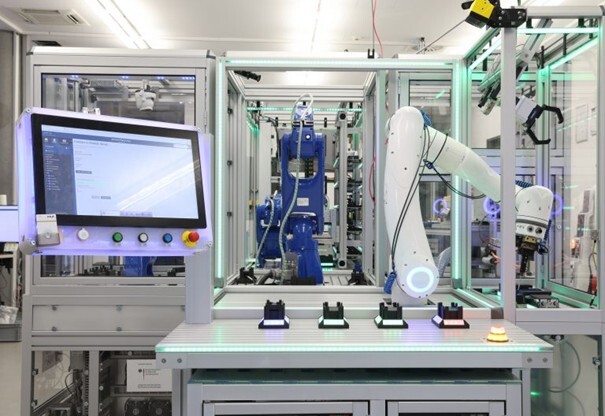
Intelligent "control center" of the production island_PHUKET of the smartFactory-KL with AI-based worker assistant from Empolis and remote knowledge database for the use case Manufacturing as a Service and Autonomous Operations as a Service.
Concrete benefits: What are the practical benefits?
For production managers and managing directors, questions naturally arise immediately: Is it worth it? What do I actually gain by relying on AI knowledge management? The short answer: you have less downtime, fewer rejects, better utilized personnel - and at the end of the day, lower costs and higher delivery reliability.
The long answer is: there are a whole range of tangible benefits from which companies profit directly:
- Fewer breakdowns and downtime: problems are detected early and rectified more quickly. AI dramatically reduces diagnosis and repair times - often from hours to minutes. Unplanned downtimes normally cost a lot of money; we can remedy this by making the machine as self-healing as possible or immediately diagnosing it remotely. The systems run uninterrupted for longer.
- Higher productivity: With longer machine running times, output naturally increases. In the example above, the night shift could be fully utilized - a competitive advantage. Studies from our project environment show that companies with remote operation and AI support were able to produce up to 5 times more parts in unmanned shifts because the usual waiting times for a technician are eliminated. In addition, optimization through AI (e.g. adjustment of parameters in real time) enables higher throughput in the ongoing process. All of this increases efficiency.
- Quality and error prevention: Every known cause-and-effect relationship is documented and available for future reference. This avoids repeat errors - the same error does not happen umpteen times without lessons being learned. AI also helps to reduce human operating errors, for example by warning if a step has been forgotten. Overall, product quality increases because the process knowledge in the system ensures consistent processes. And if an outlier does occur, the error analysis is accelerated so that countermeasures can be taken quickly.
- Better decisions & faster response: Whether it's the shift supervisor facing a tricky decision or the technician on the phone - they all make more informed decisions with AI support. The system provides hard facts and suitable solutions, which means you no longer have to replace parts on suspicion or spend a long time trying things out. Decisions are made faster, more reliably and based on data. As a result, they save time and nerves, and employees gain confidence because they realize that the recommendations work: The recommendations work.
- More efficient staff deployment: Thanks to remote technology, the best experts can be anywhere at the same time. Instead of being tied to one location, central experts can keep an eye on several plants. This means that a company may be able to dispense with expensive 24/7 shift staffing on site and still be productive around the clock. The existing employees are deployed more productively. And in times when there is a shortage of skilled workers, a solution like this can partially close the gap - a real life saver for companies that would otherwise not have the capacity to cover nights or weekends.
- Faster induction & knowledge retention: New employees have access to the entire knowledge history. They learn on the job with the support of AI and make faster progress. At the same time, expert knowledge is retained in the company, even when staff change. The system never forgets. In this way, companies transform implicit knowledge into permanently available digital expertise - a treasure that should not be underestimated.
- New services and business models: Last but not least, AI knowledge management opens up new business opportunities. For example, customers can be offered remote monitoring or guarantees on system availability - for an additional charge, of course. Some machine manufacturers are already taking the route of selling "machine + operation" as a package (keyword equipment-as-a-service). With a strong standardized knowledge system behind them, even medium-sized companies can offer such services because the support is scalable. Knowledge thus becomes a source of revenue, not just internal help. And satisfied customers whose machines run smoothly are guaranteed to come back for new orders.
As you can see, all of this is closely linked: Less downtime means more output and quality, which in turn saves costs and makes customers happy. Better decisions and error prevention protect against expensive breakdowns. Efficient staff deployment gets the best out of your team. And new digital business models can even generate additional revenue. All of this is possible if you consistently use the collective knowledge of your production with AI technology.
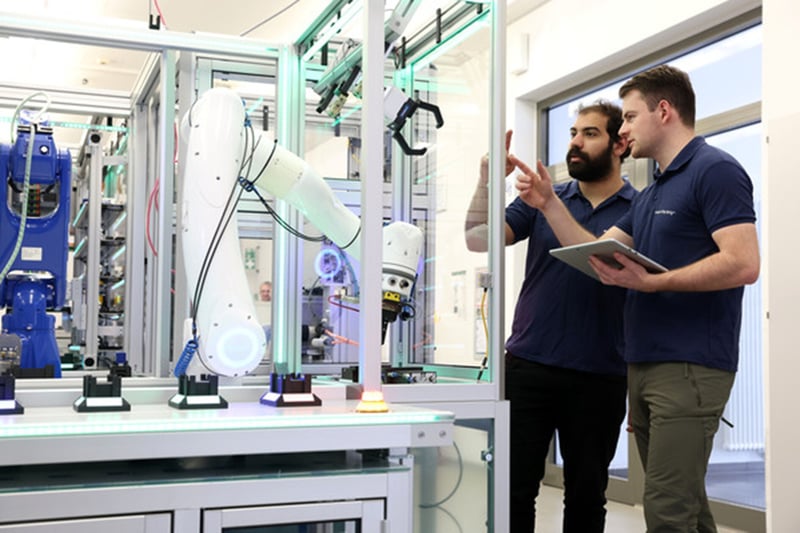
The Production Island_PHUKET demonstrates the Factory-X use cases Manufacturing as a Service and Autonomous Operations as a Service
Conclusion: Shaping the factory of tomorrow with knowledge and AI
The factory of the future is not necessarily the one with the most robots or the most dazzling high-tech - it is the factory that learns the smartest from its data and knowledge. AI-supported knowledge management will be the decisive factor in making production systems resilient, flexible and efficient.
Our example from the Factory X project clearly shows that when machines, AI and human experts work hand in hand, challenges such as the shortage of skilled workers can be overcome. Remotely managed systems, supported by an intelligent knowledge platform, run longer and with fewer faults. Employees are relieved of routine problems and can concentrate on adding value. And companies can offer their customers a new quality of service.
At Empolis, we are proud to be helping to shape this development. Our AI solutions are already being used by many industrial companies to realize precisely these benefits. "Knowledge is power" - this saying applies more than ever in Industry 4.0, but one could add: Only with the right AI does knowledge really become added value. In the future, factories will increasingly become learning organizations in which every machine and every process step supplies data and the central brain - the knowledge management system - derives smart decisions from this.
At Empolis, we are working on constantly developing this brain and making it accessible to everyone. So the next time you are faced with a tricky decision in your production or a malfunction occurs at 3 a.m. - imagine having a digital assistant whispering to you: "No problem, I have a solution - try this...".
We will be happy to accompany you on the way there. Because as a technology leader for knowledge-centric AI solutions, we are convinced that together we can make your production more productive, smarter and more sustainable - with knowledge and AI as the keys to a strong industry.